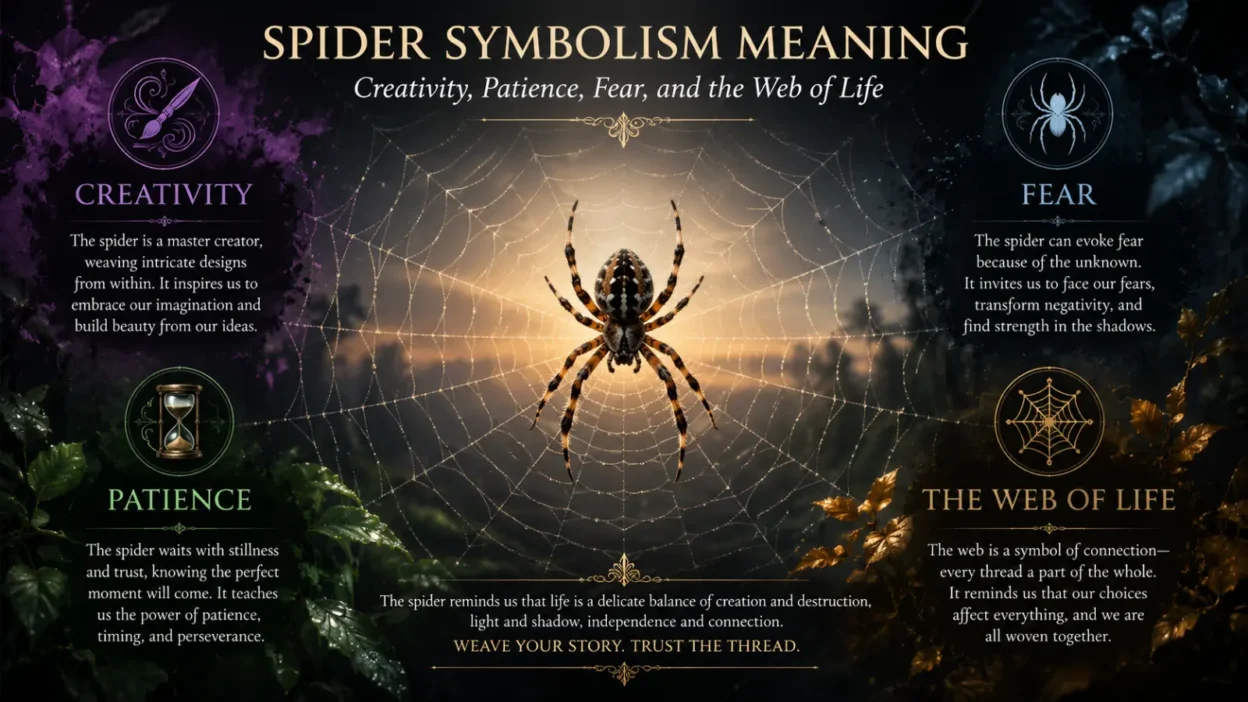
The phrase spider symbolism meaning usually points to one main idea: the spider as a maker. Because spiders spin silk, build webs, wait, repair, and begin again, people often read them as symbols of creativity, patience, strategy, and the hidden connections between things.
But spiders also carry a second meaning. Many people fear them. In the United States, a spider can suggest danger, anxiety, Halloween, haunted spaces, or the feeling of being trapped.
That mix is what makes spider symbolism so useful. It can be hopeful or unsettling. It can mean careful creation, clever survival, spiritual teaching, personal fear, or a reminder that life is more connected than it first appears.
Quick Answer
Spider symbolism meaning most commonly points to creativity, patience, and the careful shaping of one’s life. Historically, spiders also appear in myths, folklore, and religious stories as weavers, tricksters, teachers, feared creatures, and signs of fate or entrapment.
TL;DR
- Spiders most often symbolize creativity and patience.
- Webs add meanings of connection and complexity.
- Fear gives spiders their darker symbolism.
- Cultural meanings vary and should not be blended.
- Tattoo meanings depend strongly on context.
- Omens and dreams are interpretations, not facts.
What a Spider Symbol Represents Today
In modern U.S. culture, a spider usually symbolizes creativity, patience, mystery, fear, and complexity. The meaning depends on where the spider appears. A spider on a Halloween decoration feels different from a spider tattoo, a dream, a children’s story, or a religious image.
The most common positive meaning comes from web-making. A spider creates structure from its own body. That makes it easy for people to connect the spider with art, writing, planning, craft, and building a life one thread at a time.
The most common negative meaning comes from fear. Spiders move quickly, hide in corners, and have a body shape many people find unsettling. Even when a spider is harmless, the image can suggest danger, discomfort, or being caught.
| Symbolic Meaning | Why It Developed | Modern U.S. Use | Caution |
|---|---|---|---|
| Creativity | Webs look crafted and intentional | Art, writing, tattoos, decor | Not every spider makes a visible web |
| Patience | Many spiders wait for prey | Personal growth, discipline | This is symbolic, not moral behavior |
| Fear | Spiders trigger disgust or anxiety | Horror, Halloween, thrill imagery | Most spiders are not serious threats |
| Connection | Webs link many points | Spiritual writing, digital metaphors | Avoid calling it universal |
| Entrapment | Webs catch and hold | Dreams, tattoos, prison imagery | Meaning depends on context |
Why Webs Make Spiders Symbols of Creativity and Patience
The web is the center of most spider symbolism. It is visible, delicate, useful, and easy to turn into metaphor. A web can look like lace, a net, a map, or a hidden system.
That is why spiders often stand for makers.
This is also where patience enters the meaning. A web is not only a display of skill. It is a waiting tool. The spider builds, rests, senses movement, and responds when the right moment comes.
For readers today, that can become a symbol of slow work. A spider may represent writing a book, building a business, healing after loss, learning a craft, or making choices that only show results later.
Still, it helps to keep the symbol grounded. Spiders do not weave because they are “wise” in a human sense. People give the web meaning because it looks like something humans understand: craft, planning, and persistence.
The Shadow Side: Fear, Danger, and Feeling Trapped
Spiders also symbolize fear. This meaning is not hard to understand. Many people react to spiders before they think about them. Their legs, speed, hiding places, and sudden appearance can create a strong physical response.
In symbolism, that fear often becomes a sign of what feels hidden or hard to control. A spider in a dream, painting, or horror scene may point to anxiety, dread, secrecy, or a problem that has been ignored too long.
The web adds another darker layer. A web can mean connection, but it can also mean entrapment. To be “caught in a web” is to be stuck in a situation, relationship, lie, debt, habit, or emotional pattern.
This is why spider images work so well in horror. They combine intelligence, stillness, patience, and capture. The spider does not need to chase loudly. It waits.
At the same time, symbolism should not turn into misinformation. Most spiders are not out to harm people. Their symbolic link with danger is often stronger than their real danger in everyday life.
Ancient Greek Roots: Arachne and the Cost of Pride
One of the best-known spider stories in Western tradition is the story of Arachne. In the classical version many readers know, Arachne is a gifted weaver who challenges a goddess connected with weaving. After the contest, Arachne is transformed into a spider.
This story shaped later Western ideas about spiders as weavers. It links the spider with craft, skill, pride, punishment, and transformation. It also connects the spider to the tension between human talent and divine authority.
The Arachne story should not be treated as the origin of all spider symbolism. It is one important myth in a specific literary and cultural tradition. Other cultures developed spider meanings in very different ways.
For a modern reader, Arachne can suggest both creative excellence and the danger of arrogance. But the story is also more complex than a simple warning. It raises questions about power, art, truth-telling, and what happens when a human artist challenges authority.
That complexity is often lost when the myth is reduced to “spiders mean pride.” A more careful reading is that spiders can symbolize skill under pressure, the beauty of craft, and the cost of crossing sacred or social boundaries.
Anansi and the Spider as Trickster, Storyteller, and Survivor
In West African and African diaspora traditions, Anansi is one of the most important spider figures. Anansi is often a trickster, a clever character who uses wit, language, timing, and misdirection to survive.
This gives the spider a different meaning from Arachne. Here the spider is not only a weaver of thread. He is also a weaver of stories, schemes, lessons, and social truths.
Trickster figures are rarely just “good” or “bad.” They can be funny, selfish, wise, foolish, helpful, disruptive, or all of these at once. Their stories often teach by showing what happens when cleverness meets greed, pride, hunger, weakness, or power.
For U.S. readers, Anansi also matters because stories traveled across the Atlantic through African diaspora communities. In that setting, the spider’s small size and quick mind can suggest survival under pressure.
This meaning should be handled with respect. Anansi is not a generic spider symbol that can be detached from the cultures that carried the stories. He belongs to living traditions, oral storytelling, and historical memory.
Southwestern Indigenous Traditions and the Need for Respect
Some Indigenous traditions in the Southwestern United States include Spider Grandmother or Spider Woman figures. These figures are often associated with creation, weaving, teaching, guidance, or the ordering of life.
This is one reason spider symbolism can include wisdom, protection, and sacred making. The image of the spider as a weaver can become a way to speak about how worlds, stories, families, and responsibilities are formed.
But this area requires care. There is no single “Native American spider meaning.” Indigenous nations have distinct languages, histories, ceremonies, and stories. A symbol in one tradition should not be treated as a symbol for all.
Modern U.S. culture often borrows Indigenous imagery too casually. That can turn sacred or community-rooted stories into decoration. A respectful article should not treat Spider Grandmother or Spider Woman as a trendy spiritual label.
A better approach is simple: name the meaning only in broad terms, acknowledge that traditions differ, and avoid using sacred material as if it were open symbolism for anyone to claim.
Spiders in Religion, Folklore, and Omen Beliefs
Spider meanings also appear in religious stories, folk beliefs, and household superstitions. These meanings vary widely, and they should be presented as belief or tradition rather than fact.
Common folk interpretations include:
- A spider in the house as a sign of luck or money
- A spider descending on a thread as a message or arrival
- Killing a spider as bad luck in some traditions
- A web as a sign of protection, patience, or neglect
- A spider near the body as a warning to slow down
These beliefs can be meaningful to people without being provable. A superstition does not need scientific proof to matter culturally. It shows how people try to read ordinary events as part of a larger pattern.
The key is not to overstate it. Seeing a spider does not reliably predict money, love, danger, or spiritual change. It may simply be a spider. The symbolic meaning comes from the story people attach to the encounter.
How Spider Meaning Changed in the United States
In the United States, spider symbolism is shaped by several forces at once: folklore, Christianity-influenced moral stories, African diaspora storytelling, Indigenous traditions, Halloween, horror movies, tattoos, comic books, and internet spirituality.
That blend makes the spider unusually flexible. It can be a creepy creature in October, a superhero emblem, a tattoo of resilience, a witchy decor motif, or a symbol of creative patience on a journal page.
The spider web has also gained new life as a digital metaphor. People talk about networks, the web, links, threads, and being connected. Even when a literal spider is not present, spider language still shapes how people describe connection.
This modern meaning is not purely ancient. Some of it comes from old stories, but much of it comes from recent media. Horror films, Halloween aisles, fantasy games, superhero stories, and social media art all keep changing how the spider feels.
So for a U.S. reader, the spider is rarely one thing. It is nature, fear, craft, internet language, body art, and pop culture at the same time.
Spider Tattoos, Web Tattoos, and Personal Identity
A spider tattoo often means patience, independence, creativity, survival, mystery, or comfort with what others fear. Some people choose it because they feel connected to the spider’s quiet persistence. Others choose it for a gothic, protective, or striking look.
A web tattoo can have related meanings, but it also carries more complicated associations. In some tattoo and prison contexts, spider webs have been linked with time served, feeling trapped, or hard life experience. In other settings, people use webs to mean recovery, endurance, or the ability to rebuild.
This does not mean every spider or web tattoo has a prison meaning. Tattoo interpretation depends on placement, style, wearer, community, and surrounding imagery. A small fine-line spider on the wrist sends a different message from a large web on the elbow.
There is also a sensitivity issue. Some people use spider tattoos with references to Indigenous stories, especially ideas of Spider Woman or Grandmother Spider. That can be meaningful for people connected to those traditions, but casual borrowing can feel disrespectful when sacred stories become fashion.
The safest reading is this: a spider tattoo is personal first. It may suggest resilience, craft, fearlessness, secrecy, patience, or transformation, but the wearer’s own reason matters most.
Spiders in Decor, Fashion, Branding, and Digital Culture
Spiders are common in U.S. decor and fashion because they create an instant mood. A spider image can make a room feel spooky, gothic, witchy, elegant, dangerous, or strange.
Halloween is the most obvious example. Plastic spiders and fake webs turn ordinary homes into haunted spaces. In this setting, the spider usually means fear, decay, old houses, darkness, and playful danger.
In fashion, spiders can suggest edge and mystery. A spider brooch, lace web pattern, or black spider graphic often signals a taste for the unusual. It can also point to gothic style, punk influence, fantasy, or occult-inspired design.
In branding and digital culture, webs often suggest networks. The spider itself may not appear, but the idea of the web is everywhere: connections, threads, links, traps, and systems. That language keeps spider symbolism alive in a modern form.
This is aesthetic reuse. It may borrow from older meanings, but it does not always carry religious or folkloric depth. Sometimes a spider is chosen because it looks memorable.
Dream Meanings and Psychological Interpretations
Dreams about spiders are common because spiders already carry strong emotional charge. For one person, a spider dream may feel creative. For another, it may feel threatening.
A cautious interpretation starts with the emotion of the dream. Was the spider building, watching, chasing, biting, hiding, or simply present? Did the dream feel calm, tense, trapped, curious, or disgusted?
Possible interpretations include:
- creativity that is forming slowly
- anxiety about being trapped
- fear of a hidden problem
- awareness of a complicated relationship
- patience before taking action
- discomfort with control or manipulation
These are interpretations, not fixed rules. A spider dream does not have one meaning for everyone. The same image can carry different messages depending on the dreamer’s life, fears, memories, and beliefs.
The best use of dream symbolism is reflection. Ask what the spider made you feel and where that feeling appears in waking life.
How to Interpret a Spider Symbol Without Overreading It
A spider symbol is strongest when read in context. The same spider can mean craft in one place, fear in another, and sacred teaching in another.
Use these questions before choosing a meaning:
- Is the spider building, waiting, attacking, or hiding?
- Is the web shown as beautiful, protective, dusty, or trapping?
- Is the context religious, folkloric, decorative, personal, or commercial?
- Is the meaning tied to a specific culture?
- Is the interpretation modern, historical, or purely personal?
- Is fear part of the image, or is the spider calm?
This keeps the interpretation honest. It prevents a common mistake: taking a symbol from one tradition and applying it everywhere.
In general, the spider is best understood as a symbol of making and complexity. From there, the meaning can turn toward patience, fear, survival, storytelling, entrapment, or connection.
FAQs
What does a spider symbolize spiritually?
Spiritually, a spider often symbolizes creativity, patience, connection, and the slow shaping of one’s path. This is a modern interpretive meaning, and it should not be treated as a fixed rule across all religions or cultures.
Is seeing a spider a good or bad sign?
In some folk beliefs, seeing a spider can be read as good luck, money, protection, or a reminder to be patient. In everyday life, it may simply mean a spider found food, shelter, or warmth nearby.
What does a spider tattoo mean?
A spider tattoo can mean resilience, mystery, independence, creativity, patience, or comfort with darker imagery. A web tattoo may also suggest feeling trapped or surviving a difficult period, but meaning depends on the wearer and design.
What does a spider web symbolize?
A spider web often symbolizes connection, complexity, craft, patience, and the way small actions link together. It can also symbolize entrapment, especially when the web is shown as something that catches or restricts.
Are spiders symbols of femininity?
Spiders can be linked with femininity in some traditions because of weaving, creation, and certain female figures in myth or folklore. That meaning is not universal, and it should not be forced onto every spider image.
What does dreaming about spiders mean?
A spider dream may point to anxiety, creativity, feeling trapped, or awareness of a complex situation. The most useful clue is the feeling of the dream, not a fixed dream dictionary meaning.
Why are spiders used so much in Halloween imagery?
Spiders fit Halloween because they are linked with fear, darkness, old houses, hidden corners, and webs. The image works quickly because many people already react strongly to spiders.
Conclusion
The clearest meaning of the spider is careful creation. A spider builds, waits, repairs, and responds. That is why it so often represents creativity, patience, strategy, and the invisible threads that connect one choice to another.
But spider symbolism meaning also includes fear, entrapment, folklore, sacred teaching, trickster wisdom, tattoos, and modern style. The meaning changes with culture, setting, and personal experience.
A careful reading does not make the spider larger than the evidence. It simply notices why this small animal has become such a flexible symbol in human imagination.